Re-imagining

I’m Mike. A mental health counsellor, and entirely unrepentant nerd. These aren’t exclusive ideas. For ages I thought they were. I thought I’d crossed the line by having a Pokemon as my practice mascot. But for anyone who understands the significance of Sylveon, or has watched my video on the topic, you’ll know exactly what I’m saying whenever you see a Sylveon in something I make.

In training courses and at university, we’re told to be authentic to a degree, and present ourselves professionally. There’s even been judgmental comments in therapist groups about people who wear jeans or a t-shirt to work. But what does that mean for people whose authentic expression doesn’t really match traditional professionalism?

“Nerd. One whose unbridled passion for something defines who they are as a person, without fear of other people’s judgment.”

Zachary Levi

At the start of September I created a blog – The Nerd Therapist. It’s a resource page which explains children’s media and popular culture to therapists and other child-serving professionals. Due to the demands of professional life and personal interest, there aren’t many people in the field who do nerdy things, but might work with the people that do. As a nerd and a therapist, I’ve been able to riff and banter with the young people I work with because we have a shared culture, and narratives. I’ve helped other clinicians understand the people they work with who rely on these narratives to express themselves.

Within five days I had a hundred followers, a handful of requests from therapists to help understand their clients, and a job offer.

Within the month I had a thousand followers, several invitations to coffee meetups, a radio spot, and a whole host of awesome conversations about mental health and popular culture.

This experience has been surreal. The interest, and the conversations I’m having about The Nerd Therapist project, has taken me completely by surprise. I expected criticism and negativity, but I’ve received nothing but enthusiasm and support. And this has been so invigorating, so empowering and affirming that I’ve never been so energised while working in the field.

Resistance is experienced as fear; the degree of fear equates to the strength of Resistance. Therefore the more fear we feel about a specific enterprise, the more certain we can be that that enterprise is important to us and to the growth of our soul. That’s why we feel so much Resistance. If it meant nothing to us, there’d be no Resistance.”

Steven Pressfield

But in the back of my mind, anxiety – Resistance, as Pressfield puts it – tells me that this is unprofessional. That it’s silly, and I’m projecting. And when resistance rears its ugly head, I know I’m going the right way. This isn’t Suit and Tie, Boardroom Professionalism. This is professionalism in the form of meeting the clients where they are. And I don’t need to step into their world – because I’m already part of it.

I’m meeting resistance, and I’m going to break through it.

Whatever happens, I’ve already won. I will continue to win every time someone sees my example and feels the freedom to be their own flavor of freak, and express themselves unapologetically.

Yvie Oddly

I’m following my own advice – living with passion and authenticity. I’m creating resources for clinicians – and the first one isn’t far away from being released. I’m bringing tabletop roleplaying games into the therapy room. I’m no longer afraid of looking unprofessional – because I’m no longer ashamed of being The Nerd Therapist.

So I’m doing a little rebrand, as you may have noticed. Counselling with Mike – The Nerd Therapist. Combining who I am, with what I do, in the hopes that I can speak to the hearts of everyone out there who has felt like they’re not understood or accepted because of the books they read, the movies they watch, or the games they play.

Good vibes and victory

Mike.
Invalidation and trauma

Tw/cw – invalidation, trauma, gaslighting. Please be mindful before continuing.

Today I’d like to take a moment to talk about invalidation.

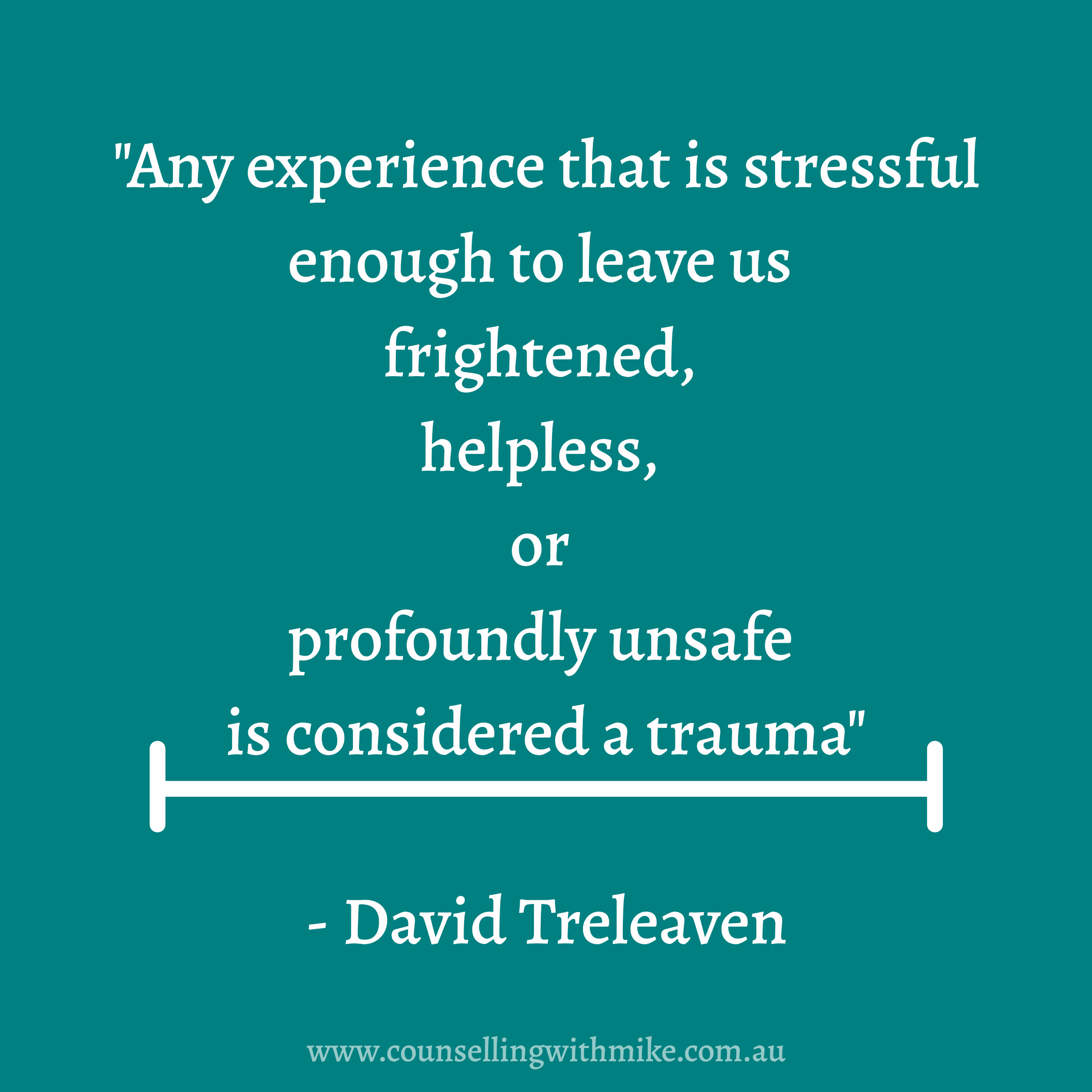
To everyone who has ever heard, or said, “its all in your head”, I offer this: Your whole life happens there. Our experiences shape the way we see and interact with the world. What you’ve experienced is real. Trauma can arise from perceived experiences as well as real ones. Your experiences are real, and valid.

Invalidation is when someone denies, dismisses or rejects someone’s feelings – even their own. As a teenager I couldn’t have even considered that what I was feeling was depression. That what I as a child, had experienced was traumatic grief. I invalidated myself with my own rejection.

I’ve met people who don’t see their experiences as valid, or for whom it’s taken a lot of work to understand that their experience is. Sometimes we don’t recognise it until we’re looking back on it after healing. When we make a new normal, we have a fresh perspective on the full extent of the old one.

Mindful communication

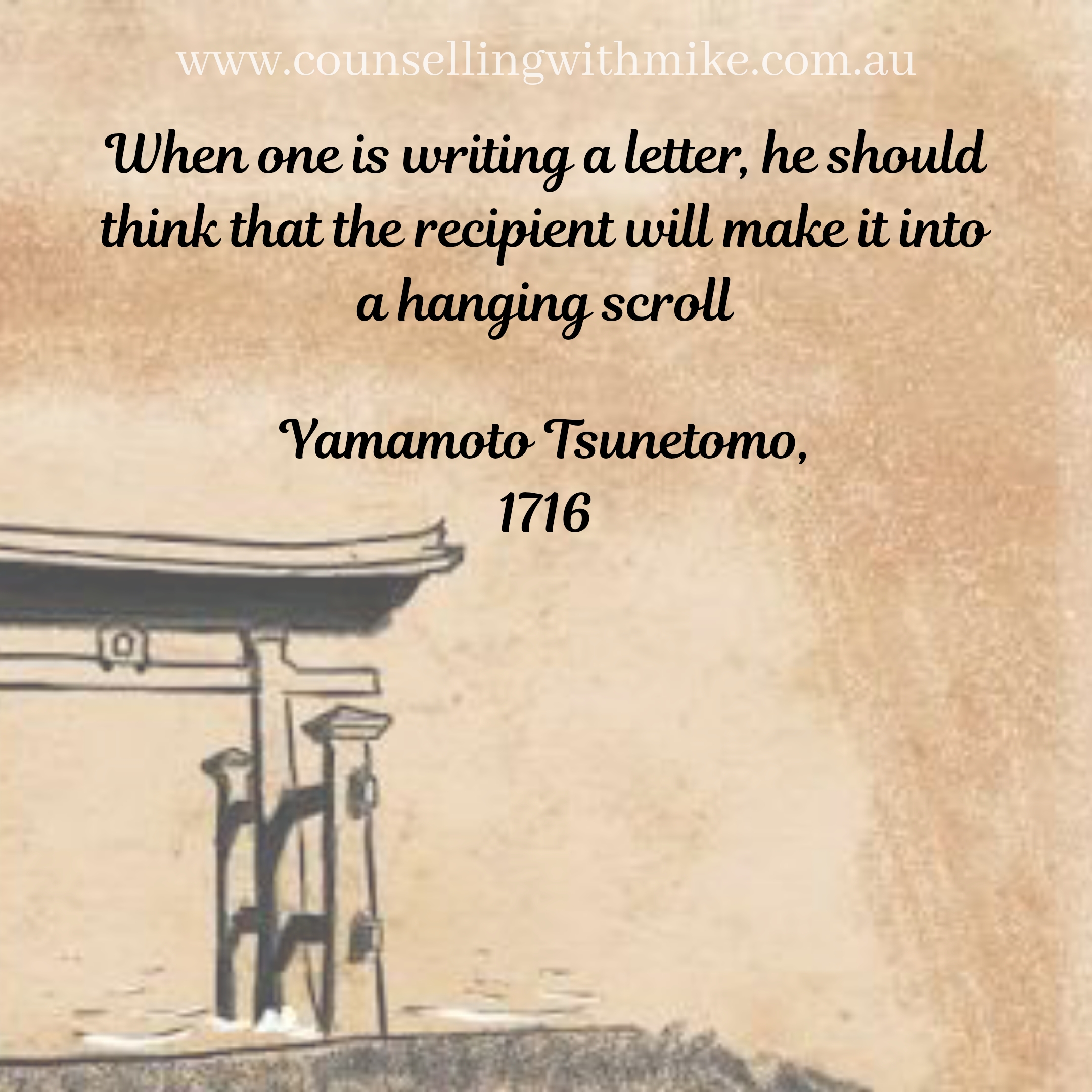
When I was on the railways I found myself devouring books on world philosophy, in search of wisdom and meaning. Reading these brought me to seek a more fulfilling calling in life, and when I learned about counselling, and how it could be a career option for me, I knew I’d found my path. One of these texts, “Hagakure”, written by a samurai who worked as a scribe, is the source of the quote above.

Our words are more powerful that many of us ever come to fully realise. Often, we cannot predict the impact they may have on others. A single careless statement made without thought, could echo in the minds of others for a lifetime.

So the best thing we can do, is put care into the way we express ourselves, to ensure we only say what we mean – and mean what we say. It’s not always easy, and its not always going to succeed, but we owe it to those around us, and our positive relationships with them, to ensure that our words don’t cause inadvertent harm.

After all, we don’t get to decide how others feel about our words or actions.

But of course, there’s many ways you could interpret this quotation. What do you think it could apply to?

Anxiety, curiosity and new opportunities

I’m departing from my usual posts for clients and prospective clients today. This one is for the early career psychologists, counsellors, and students.

Today I had the honour and privilege to attend a skills training session with LifelineWA and their DBTeen program. The program is pretty self-explanatory, it provides dialectical behaviour therapy (DBT) to adolescents. I am so grateful to the program coordinator for accepting me into the role.

I got to spend today with a dozen amazing individuals, and I only wish I had the time to talk to all of them at the length I only managed with a few. I got to engage in a truly serene mindfulness experience, and learn about the cornerstones of DBT in practice.

I have been interested in pursuing DBT since the second year of my degree (2017) and I cannot understate how excited I am to engage in this program with them. I’ll have a trainee-observer role, and will have the opportunity to learn first hand from experienced clinicians.

Opportunities like this are certainly few and far between. Training is often prohibitively expensive, especially in niche or specialist areas.

Networking is honestly a trait that will take you so many interesting places and provide you with so many opportunities. Building a network, or even just sending emails or following newsletters, can give you a vital and invigorating level of awareness of opportunities and options open to us.

It can be so hard to learn, and the anxiety can be so challenging to overcome, but we deny ourselves amazing opportunities when we don’t put ourselves out there.

For now though, I’ve got a thick DBT book to get acquainted with. There’s so much to learn – I must admit I don’t feel quite ready. But I’m here to learn, and thats perfectly okay.

We start in a couple weeks. I can’t wait.

I’m anxious and curious. It feels amazing.

Passion!

I chose the cover photo for the peer support team I work with in schools. It reads “passion led us here”.

Passion is an essential value for me. It led me to pursue counselling as a way of life, and it kept me on track during my studies. Its my fervent hope that it will be as reliable in the future.

Today, think about your passion in life. What excites you? What lights a fire in your heart that isn’t easily ignored?

A beautiful and often understated role a counsellor can play, is in helping you find, embrace and pursue the things that really matter to you. To live an authentic, self-actualised life.

Growth and striving are not always easy, but what is?

Services for Melbourne and Covid-19 impacted communities

I’ve said before that the benefit of conducting sessions online means I can be accessed at your convenience. In times like these – the Covid-19 pandemic, it also means counselling can be accessed in safety, if you’re concerned about becoming exposed.

As I watch with a second wave hit the east coast, I am reminded of what brought me to counselling to begin with – a genuine desire to help people in times of need. The pandemic has really brought me back to my values and I’m working on exploring options to support those affected.

I am offering my services at concession rate to anyone in an area affected by Covid-19 or quarantine measures, or anyone personally affected by Covid-19.

If you’re in isolation or lockdown, I’m here for you. Don’t be afraid to reach out for a chat, to see what I can offer you.

Body scan meditation

The body scan meditation is another potent tool for relaxation, anxiety, and releasing stress. It can also be surprising – especially if you find yourself holding tension in areas you’d hardly considered. This does more than relieve tension – it helps you recognise it, helps you find where stress is stored in your body. During my time as an intern for a clinical psychologist, the psychologist I was working for was an advocate for regular massages to relieve these stress areas.

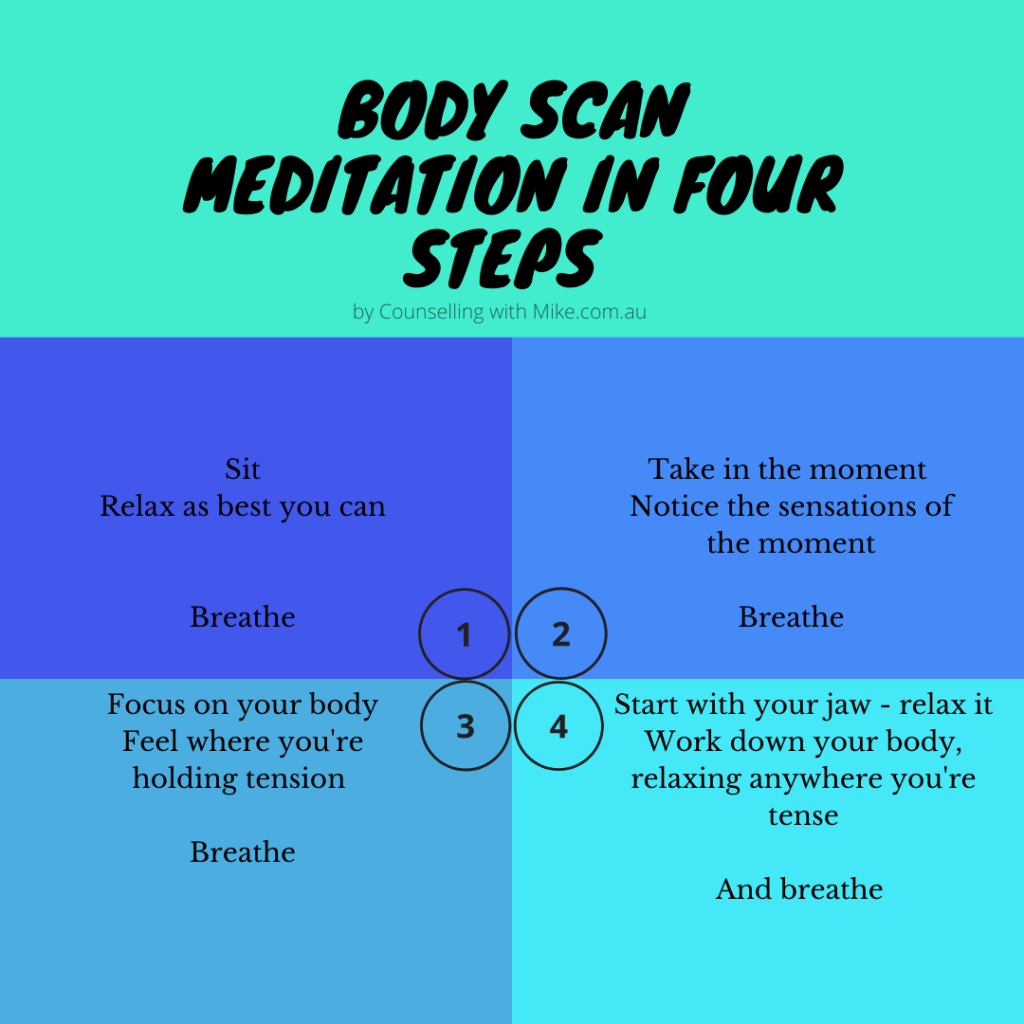
Below is a poster which breaks the technique down into simple steps. Beneath that is a script you can use to get started.

Sit, if you can. In a chair or on the floor.

Take a deep breath in. Hold it for three seconds, and let it out. And another. Do this until you’re ready to proceed. You can also start this meditation with the grounding technique.

Take notice of the sensations in this moment. The feeling of the floor beneath you – the tiles, the carpet, the wood. The fabric of the chair you’re on. Any breeze in the air.

Keep breathing.

Start with your jaw. Unclench it. Now, to your shoulders. Relax them, let them slump at your side. These are common areas where you may carry tension.

Go through your whole body – find where is tense, and relax it. Your hands and face are more areas where we can be noticeably tense.

Keep breathing.

Once you’ve released the tension you’ve found, take one last deep breath. Hold on for three seconds, and let it out.

I hope you find this as useful as I have.

What is: Debriefing

Have you ever had something happen to you, and there’s been nobody to talk about it to? Or nobody you feel would understand, or nobody who’d just shut up for five minutes and let you finish?

Welcome to debriefing.

Debriefing is one of the more understated but valuable uses of time in the therapeutic space.

Although no longer used in response to traumatic events, debriefing can still be used in less critical scenarios.

I’ve found theres great value in just having someone to talk to about something recent that went on. Did something happen at work recently thats bugging you? Something in your family? Is it something that the person you’d normally talk to wouldn’t get?

I use debriefing quite regularly, with my supervisor and my support team. Its a great space just to get things off your chest, and be heard.

You don’t have to be in crisis to see a counsellor. You can be in any state, and we’re ready to receive you.

Reach out.

What is: Telehealth?

Providing counselling services online seems strange at first sight, but quite convenient and feels more comfortable, and natural than you’d expect. I’m a 28 year old nerd and former FIFO worker – I am no stranger to video calls and connecting with others online.

Covid-19 restrictions led to many workplaces adopting work-from-home procedures, and health providers are no exception. My home office was set up after the Education Department informed school wellbeing staff that we’d need to work from home – a framework we quickly built up and implemented.

Your right to confidentiality is still ensured, and Telehealth providers endeavour to ensure your session is secure and safe.

Telehealth services involve using video call software, like Zoom, Webex or Skype, to have a counselling session. These user-friendly experiences often only need you to click a link in order to attend the counselling room.

This means you could have a session wherever is convenient to you! Want to book a half hour session during your lunch break at work? Fine with me. During your kids’ nap time? After they go to bed? Do you work unusual hours that make traditional office hours inconvenient to you?

Being able to pop into my home office and have a web session gives you the convenience of being able to book a time that works for you, unrestricted by traditional office hours, travel or having to arrange a sitter for the kids.

Plus you’ll probably get to meet one of my furry coworkers, who just love popping into the room when they hear new voices.

So reach out, and lets talk about a time that works for you.

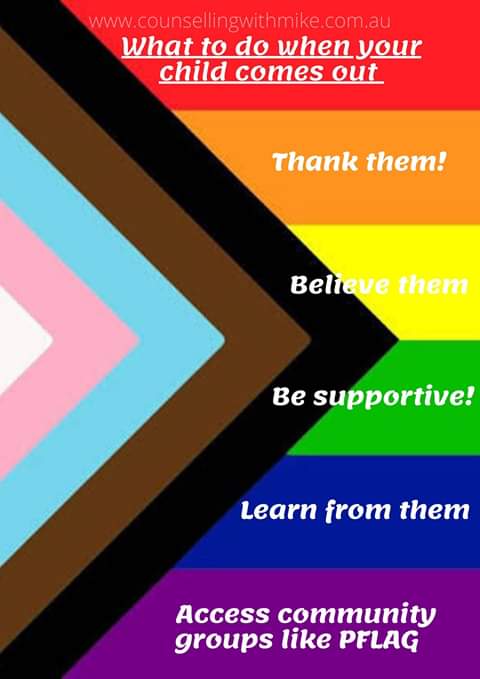
What to do when your kid comes out

So your child has come out to you. What do you do now?

You support them. Nothing has changed about them, they’re getting to live more openly. They may however start being victimised by others and will need your care and support.

You believe them. Kids are prone to phases, sure. Its how they grow, and learn, and find their identity. If you don’t believe or support them now, it tells them you don’t take them seriously, and they’ll have trouble trusting you in future.

You thank them. They likely agonised over telling you or not – how many stories are there of LGBTQIA people losing their families when they come out? This is a brave, risky moment for your child. Thank them for letting you know who they really are.

You be open to learning. Especially if you’re not really up to date on how things are for your child’s identity. You may have a lot of learning to do. Be open to it, it’ll be worth the world to them. Learning their language – a new name, pronoun and other terms may come along with this. You may have to unlearn old terms that you may have used, that you may now be told are hurtful.

You seek community resources. There’s fantastic resources out there to help parents of LGBTQIA children be supportive allies. PFLAG is a fantastic place to start!